My own Windows software
ListoMax
ListoMax did not come out of market research. In 2011 I had a PrestaShop shop and a week to fill it: two hundred products, most of them in several colours and sizes, each variant needing to become a listing of its own. After two days the arithmetic was plain: at that rate it would take a month.
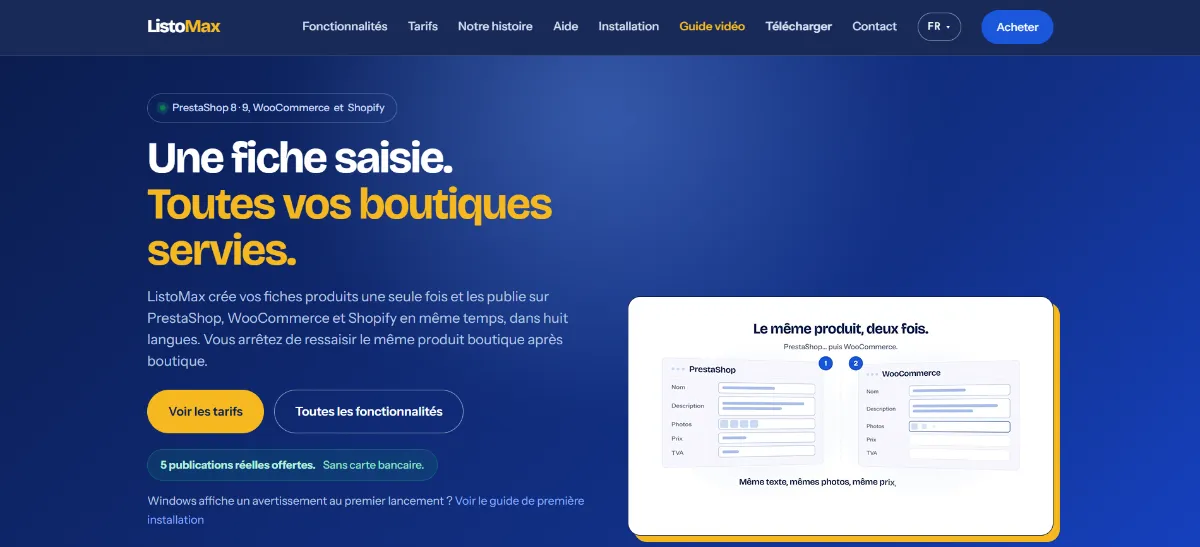
The functions built for this project
01
The Series function
The direct descendant of the 2011 tool: one form filled in once, and as many complete listings as there are variants entered. That was the real problem — not the typing, the repetition.
02
The traps in every shop platform
A parent category left unattached and the product appears nowhere. A VAT rate missing from the shop and the listing goes out tax-free. ListoMax reads the rates from the shop instead of guessing them, attaches the parents, and does not break variants when republishing.
03
Checked after publishing
After each upload the software reads the listing back from the shop to confirm it received what was sent. That takes longer to build. It is the only way to know it worked.
04
Never a silent failure
A user cannot open a developer console. If something fails, they must see it on screen, know which product is affected and why. A visible error can be fixed; a silent one loses data without anyone noticing.
05
Four targets, eight languages
PrestaShop 8, PrestaShop 9, WooCommerce and Shopify, each with its own rules. Every function is validated against real shops before it ships.
06
Sold online
The site, the licences, the installer, the video guide and the support are all part of the project. Five real publications are free to try, with no card details.
- 2 min
- To publish 12 listings in series
- 100 %
- My product: idea, code, sales, support
- 2011
- The first tool, written in a hurry
- 4
- Publishing targets
- 8
- Publishing languages
Where it started
Two hundred products, one week, and an empty PrestaShop shop. Most items existed in several colours and sizes, and each variant had to become a full listing: its reference, its photos, its description.
After two days I stopped typing and wrote a tool to do it for me. Crude, ugly, with nothing worth calling an interface — but it generated the listings and sent them to the shop. The week was enough.
What that first tool taught me
That the problem was not the data entry itself but the repetition: the same product typed twelve times for twelve colours, then once more for every shop to be filled.
That the existing tools answered a different question. The CMS platforms’ own CSV imports handle large structured volumes well, but they assume the file already exists and is clean. They do not help you create the variants, nor fill twelve listings from one.
And that the real difficulty was in each platform’s details, not in the principle. A product filed under a sub-category that appears nowhere because the parent was never attached. A VAT rate that does not exist in the shop, sending the product out tax-free. A saved change that never reaches the live site. Every one of those traps cost me hours.
Fifteen years later
ListoMax is that 2011 idea, taken all the way. The rest was built around it, following what real shops demand: parent categories to attach, VAT rates to read rather than guess, variants not to break when republishing, images genuinely uploaded, history kept so you can go back.
The software is built and supported by the same person: when a customer writes to support, I am the one who answers. Feedback therefore weighs directly on what gets built next — and turnaround depends on one person, which is stated up front rather than left to be discovered.
It is also the clearest demonstration of what I can do in business software: if your trade contains a task you redo identically, it can probably be written once and for all.
Technically
- Windows application
- PrestaShop · WooCommerce · Shopify connectors
- Licensing
- Sales site
Page updated on — written by Yvan Barbaggio, who built this project.
A project along the same lines? Describe it in two lines , or go back to all the custom projects.